
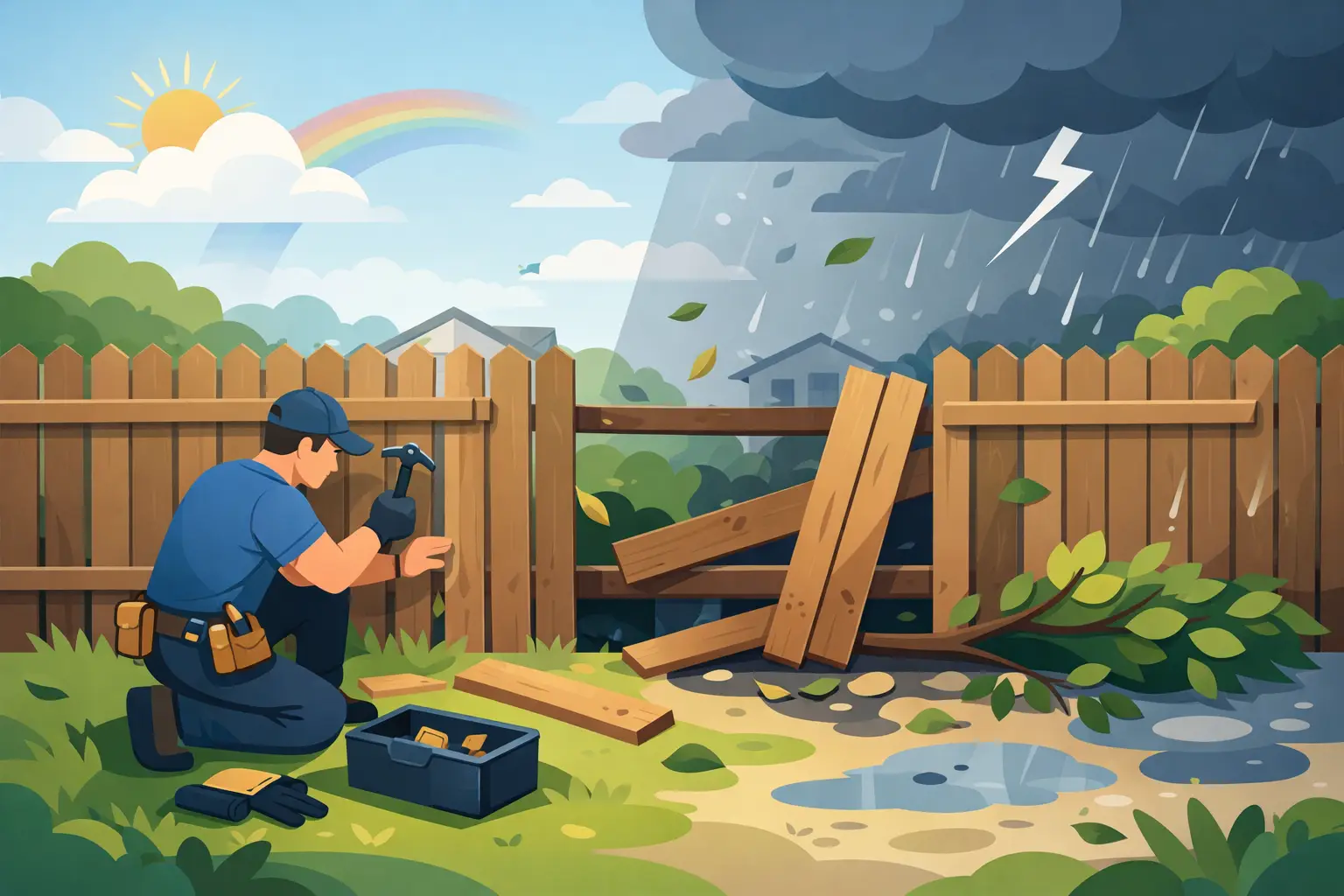
A fence often looks fine until the morning after strong wind and rain, when a loose panel, leaning post or broken rail suddenly becomes impossible to ignore. If you are searching for how to repair storm damaged fence sections, the right approach depends on what has actually failed - and whether the rest of the boundary is still sound.
Storm damage is rarely just cosmetic. A panel that has lifted out of place can put extra strain on the next bay. One rotten post can pull a whole run out of line. In some gardens, the safest and most cost-effective repair is a simple panel change. In others, patching one section only delays a wider replacement. The key is to assess the damage properly before spending money or time.
How to repair storm damaged fence without making it worse
The first job is safety. After a storm, fence sections can be unstable even if they are still standing. Concrete posts may have shifted, timber posts may be split at ground level, and fixings can be hanging on by very little. If a fence borders a public footpath, shared access or driveway, keep people clear until you know what is secure.
Start by checking the full run, not just the obvious break. Look at each post from ground level up. If a post is leaning, push it gently rather than forcing it. Too much movement usually means the base has failed or the surrounding ground has loosened. Then inspect the rails, brackets and panel edges. Wind often tears fixings out before a panel fully collapses, so a section that looks upright may already be close to failing.
It also helps to think about what caused the damage. A fence that came down because a tree branch hit it needs a different response from one that failed in normal wind. Impact damage can be isolated. Structural weakness across several bays usually points to age, rot, poor installation or materials that were already near the end of their life.
Common types of storm fence damage
Most domestic fence repairs fall into a few clear categories. Fence panels can crack, bow or blow out completely. Timber posts can snap at the base, particularly where moisture has weakened the buried section. Fence rails can split or pull away from the posts. Gravel boards may shift, and in closeboard fencing the individual boards can loosen while the frame remains in place.
Concrete components are different. They do not rot, but they can crack or lean if the footing has moved. A broken concrete post is usually a replacement job rather than a repair. With timber fencing, there is a bit more room for selective repair, but only if the surrounding structure is still solid.
This is where many homeowners lose time. They replace the visible panel, only to find the post beside it has started leaning a week later. The storm exposed the weak point, but it may not have been the only one.
When a fence can be repaired and when it should be replaced
Repair makes sense when the damage is localised. If one or two panels have blown out but the posts are straight and firm, replacing those sections is usually straightforward. The same applies to a rail that has split, a few loose boards, or damaged fixings on an otherwise sound fence.
Replacement is usually the better option when posts are rotten, several bays are moving, or the fence was already deteriorating before the storm. If more than one structural element has failed, the repair cost can quickly approach the price of new fencing. In that situation, replacing the affected run often gives better value and a more reliable finish.
Appearance matters too. A patched fence can look uneven if new timber is fitted into weathered sections. Some property owners are happy with that if the main aim is security. Others would rather replace a full run to keep the boundary neat and consistent. For landlords and residential property managers, a clean replacement can also reduce repeat maintenance.
Repairing blown fence panels
A blown panel is one of the more straightforward jobs if the posts and support system are still intact. Measure the opening carefully before buying a replacement. Not every panel will be a true standard size once older posts have shifted slightly over time.
Check the panel slots or fixings before fitting anything new. If the grooves in concrete posts are packed with debris or old timber fragments, the new panel may sit poorly. If timber battens or clips have pulled away, they need replacing as well. Simply forcing a new panel into a weak frame usually leads to another failure in the next strong wind.
Where a panel has only partly come loose, do not assume it can just be screwed back in. If the timber frame has twisted or split, re-fixing it may only be a short-term patch. A new panel is often the cleaner option.
Repairing or replacing damaged fence posts
Posts are the deciding factor in most storm repairs. If the post has gone, the fence will not stay right for long. A timber post that is rotten at the base generally needs full replacement. Surface treatments and brackets can help in some cases, but they do not solve severe decay where the main strength has already been lost.
A spur can sometimes be used where a timber post is sound above ground but unstable at the lower section. This involves securing a concrete or metal support alongside the post to stiffen it. It can be a practical repair, but only if the original post still has enough strength to justify saving. If the timber is badly split or soft, replacing it is the safer route.
Concrete posts need careful checking after storms. If one is leaning because the footing has loosened, it may be possible to reset it. If it is cracked, replacement is normally required. Concrete does not give much warning before complete failure.
Rails, boards and fixings
Storm damage does not always mean a full section has come down. Sometimes the fence remains standing but the rails have split, nails have pulled free or feather edge boards have torn away. These repairs can be worthwhile where the main posts are still solid.
Use exterior-grade fixings suitable for treated timber. Reusing bent or rusted nails saves very little and weakens the repair. If several rails have failed across different bays, pause before carrying on. Repeated rail failure can indicate the fence is taking more wind load than it was designed for, or that the timber has aged beyond reliable repair.
This is also the time to check neighbouring sections. If one bay has absorbed the worst of the storm, the next bay may have hidden stress around the joints.
Why some fences fail again after repair
A repaired fence should not feel temporary. If it does, something has been missed. One common problem is replacing the broken part without addressing the cause. That could be rotten timber, shallow post depth, poor drainage around the base, or panels that catch too much wind for the location.
Garden exposure matters in Lancashire, especially in open areas or properties that take the full weather across the back garden. Solid panels can act like sails in strong gusts. In some cases, changing to a more suitable style or reinforcing key sections makes more sense than repeating the same repair every winter.
Ground conditions matter as well. Waterlogged soil can weaken post stability, and sloped gardens often put uneven pressure on fence lines. A proper repair takes those site conditions into account.
Should you repair it yourself or call a fencing contractor?
Some minor storm repairs are realistic for a capable homeowner. Swapping a damaged panel, replacing a few boards or re-fixing loose brackets can be manageable if the structure is otherwise sound. The work becomes more difficult when posts need digging out, concrete footings need replacing, or the fence line has shifted out of level.
The main risk with DIY post repairs is ending up with a fence that looks upright on the day but starts leaning again after the next spell of bad weather. Setting posts correctly, aligning bays and making sure the whole run remains stable is where experience counts.
For larger damage, a specialist fencing contractor can usually tell quite quickly whether you are looking at a local repair or a wider replacement issue. That saves guesswork, especially where multiple sections are involved. For homeowners across Blackburn, Preston, Burnley and surrounding Lancashire areas, that practical assessment is often the difference between a short-term patch and a proper fix.
Getting the boundary secure again
The best repair is not always the smallest one. Sometimes replacing one post and one panel is enough. Sometimes the honest answer is that the damaged section has exposed a fence that was already failing. A dependable repair should leave the boundary safe, tidy and able to cope with the next run of bad weather.
If you are dealing with storm damage now, focus first on stability, not appearance. Once the fence is secure, you can decide whether a like-for-like repair is right or whether a stronger replacement would serve the property better for the long term.