
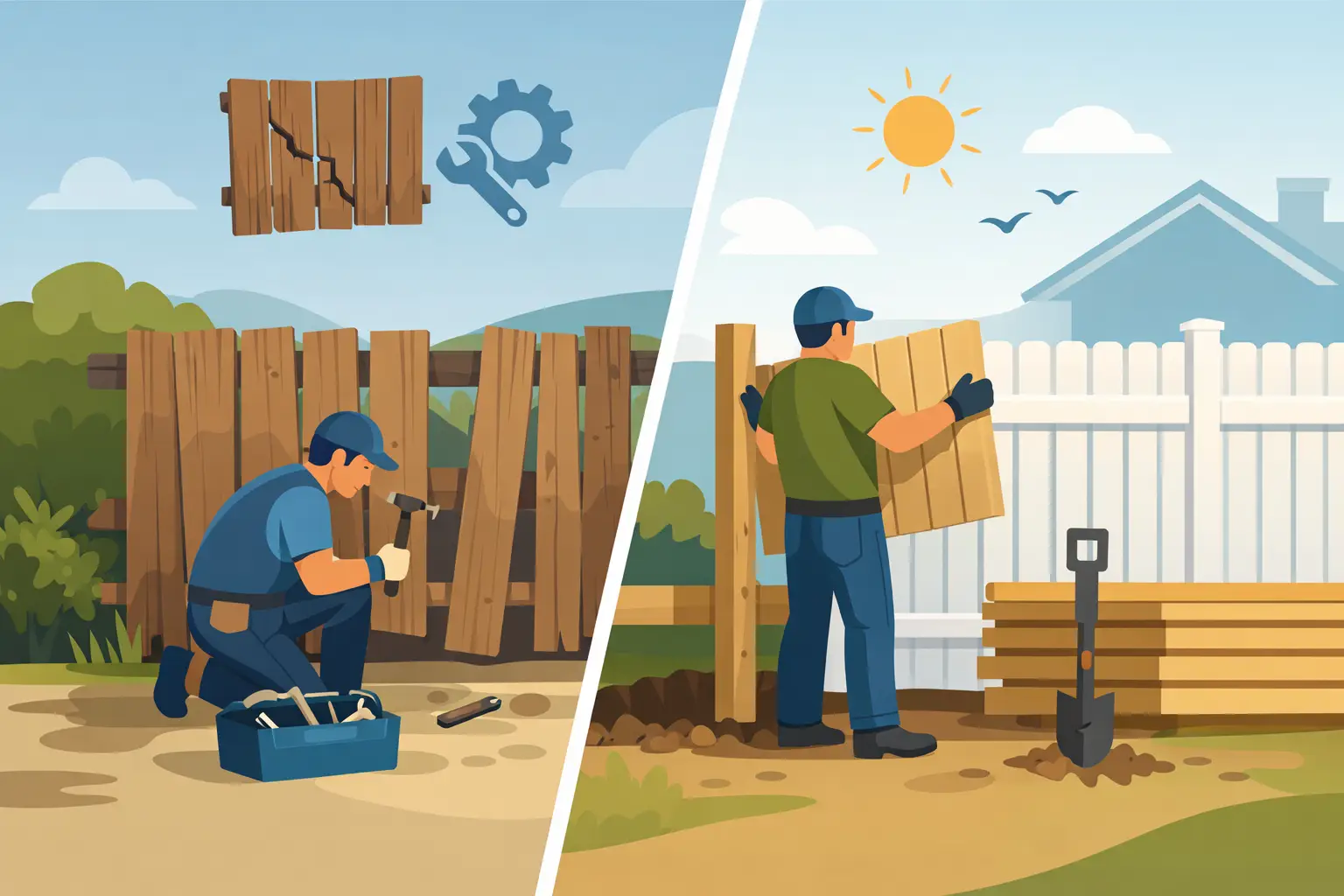
A fence rarely fails all at once. More often, it starts with a loose post after heavy wind, a panel that rattles, or a gate that no longer closes properly. When you are weighing up fence repair or replacement, the right answer usually comes down to the age of the fence, the extent of the damage and whether a repair will genuinely last.
For many Lancashire homeowners, the first instinct is to repair what is there. That makes sense if the problem is localised and the rest of the structure is still sound. A single storm-damaged panel, one broken arris rail or a gate that has dropped can often be put right without changing the whole boundary. A targeted repair is quicker, less disruptive and usually more cost-effective in the short term.
That said, a cheap repair is not always the cheaper option overall. If multiple posts are loose, timber is rotting at the base, and several sections have already been patched over time, further repair work can become a stopgap. You spend money making an old fence stand up for another season, only to face a larger bill later when the next weak point gives way.
When fence repair is the sensible option
Repair tends to be the best route when the fence is structurally sound overall and the damage is limited to one or two components. This often applies after bad weather, accidental impact or wear concentrated in a specific area. If most posts are firm, the line of the fence is straight and the timber has not reached the end of its life, a good repair can restore both appearance and strength.
A common example is panel damage. Fence panels can crack, split or blow out in strong wind while the posts remain solid. In that case, replacing the affected panel or rails is usually straightforward. The same goes for a gate that has sagged because fittings have worn or hinges have pulled slightly out of line. If the frame itself is still in decent condition, repair or refitting can solve the issue.
Minor rot is another grey area. Surface weathering is normal on timber fencing and does not always mean replacement is needed. If decay is only affecting a small area and has not compromised the fence post or support structure, a repair may still be worthwhile. The key question is whether the damaged section can be isolated without leaving hidden weakness behind.
For landlords and property managers, repair can also make sense when speed matters. If a boundary needs to be made secure quickly between tenancies, or a rear garden fence has been damaged in one section only, a focused repair can be the most practical immediate solution.
When fence replacement is the better investment
Replacement becomes the stronger choice when the fence is failing in more than one place or the original installation is no longer up to the job. This is especially true with older timber fencing where the visible damage is only part of the story. What looks like one broken section may actually point to wider movement, decay or poor previous workmanship.
Posts are usually the deciding factor. Panels can be changed relatively easily, but if the posts are rotting, leaning or shifting in the ground, the whole fence line loses stability. Replacing a few panels on weak posts often leads to repeat problems. The new sections end up supported by an old framework that is already giving way.
Appearance matters too. A fence made up of mismatched repairs can look untidy, particularly at the front or side of a property where kerb appeal counts. If several panels have been replaced at different times and heights, or if there is a mix of old and new timber, a full replacement gives a cleaner and more consistent finish.
There is also the question of suitability. Some fences simply were not built for the conditions they face. Exposed gardens, sloping ground and high-wind areas across parts of Lancashire put extra pressure on weak or shallow-set fencing. In those cases, replacing the boundary with a more appropriate system can prevent repeated call-outs and ongoing maintenance.
Fence repair or replacement after storm damage
Storm damage often creates the most uncertainty because the damage can look worse than it is, or less serious than it is. A panel on the ground does not automatically mean the full fence needs replacing. Equally, standing panels do not guarantee the structure is safe.
A proper assessment should check more than what is immediately visible. Posts may have shifted below ground even if they still appear upright. Concrete spurs may have cracked. Fixings may have twisted under strain. Where wind has hit one section hard, neighbouring sections can also have been weakened.
This is where experience matters. A trade-professional inspection can tell the difference between clean break damage and wider structural failure. If the force of the weather has only affected one bay, repair is often realistic. If the impact has exposed age-related weakness right along the run, replacement is usually the better route.
For homeowners dealing with insurance queries or urgent safety concerns, clear advice on whether a repair will hold up is just as important as the quote itself.
Cost matters, but so does lifespan
Budget is naturally part of the decision. Repair usually costs less upfront, and in the right situation that is exactly the right call. But the real comparison is not repair versus replacement on today’s price alone. It is cost versus lifespan.
If a repair adds years to a fence that is otherwise in good condition, it is money well spent. If it only delays inevitable replacement for a few months, it can be false economy. That is especially true where labour is involved in taking apart unstable sections, securing temporary fixes and returning later for further work.
Replacement often costs more at the start because materials and labour are broader in scope, but it can offer better value over time. A new fence line with properly installed posts, matching panels and suitable materials gives a fresh starting point. It also reduces the chance of ongoing maintenance bills caused by piecemeal failures.
For customers comparing quotations, the best approach is to ask what the recommended option is likely to deliver in practical terms. Not just what it costs, but how long it is expected to last, what guarantee is offered and whether any nearby sections are likely to need attention soon.
Signs your fence has reached the end of its life
Some fences make the decision easy. If several posts are loose, the panels are warped, the timber is soft at ground level and the boundary is visibly leaning, repair is unlikely to be the right investment. The same applies where repeated past repairs have left the fence uneven and unreliable.
You may also find replacement is due if the fence no longer does what you need it to do. A low, worn boundary may not provide enough privacy. An old gate arrangement may not be secure enough for children, pets or side access. In these cases, replacement is not just about fixing damage. It is about improving function.
Homeowners carrying out wider garden improvements often choose replacement for the same reason. If you are upgrading paving, landscaping or decking, an old patched fence can let the rest of the garden down. A new boundary helps bring the whole space together.
Choosing the right contractor for the job
Whether you need a repair or a full replacement, the standard of the assessment matters. A reliable fencing specialist should look at the whole run, explain what is salvageable and be clear if repair is only a temporary measure. Straight answers are important, especially when customers are trying to balance urgency, budget and long-term value.
Local knowledge helps as well. Properties across Blackburn, Preston, Burnley and surrounding Lancashire towns can face different ground conditions, exposure levels and access issues. A contractor used to working on residential boundaries in the area is better placed to recommend a fence that suits the site, rather than a one-size-fits-all fix.
Hulme Fencing Lancashire works with homeowners and property clients who want that kind of clarity - practical advice, tidy workmanship and a boundary that stands up properly once the job is done.
Making the right call for your boundary
The best decision usually comes down to one honest question: are you preserving a fence that still has solid life left in it, or trying to rescue one that is already on the way out? If the structure is sound, a repair can be the sensible and economical answer. If the weakness runs deeper, replacement will usually save time, stress and repeat cost. A good fence should not just look better on the day it is finished. It should still be doing its job when the next spell of bad weather arrives.