
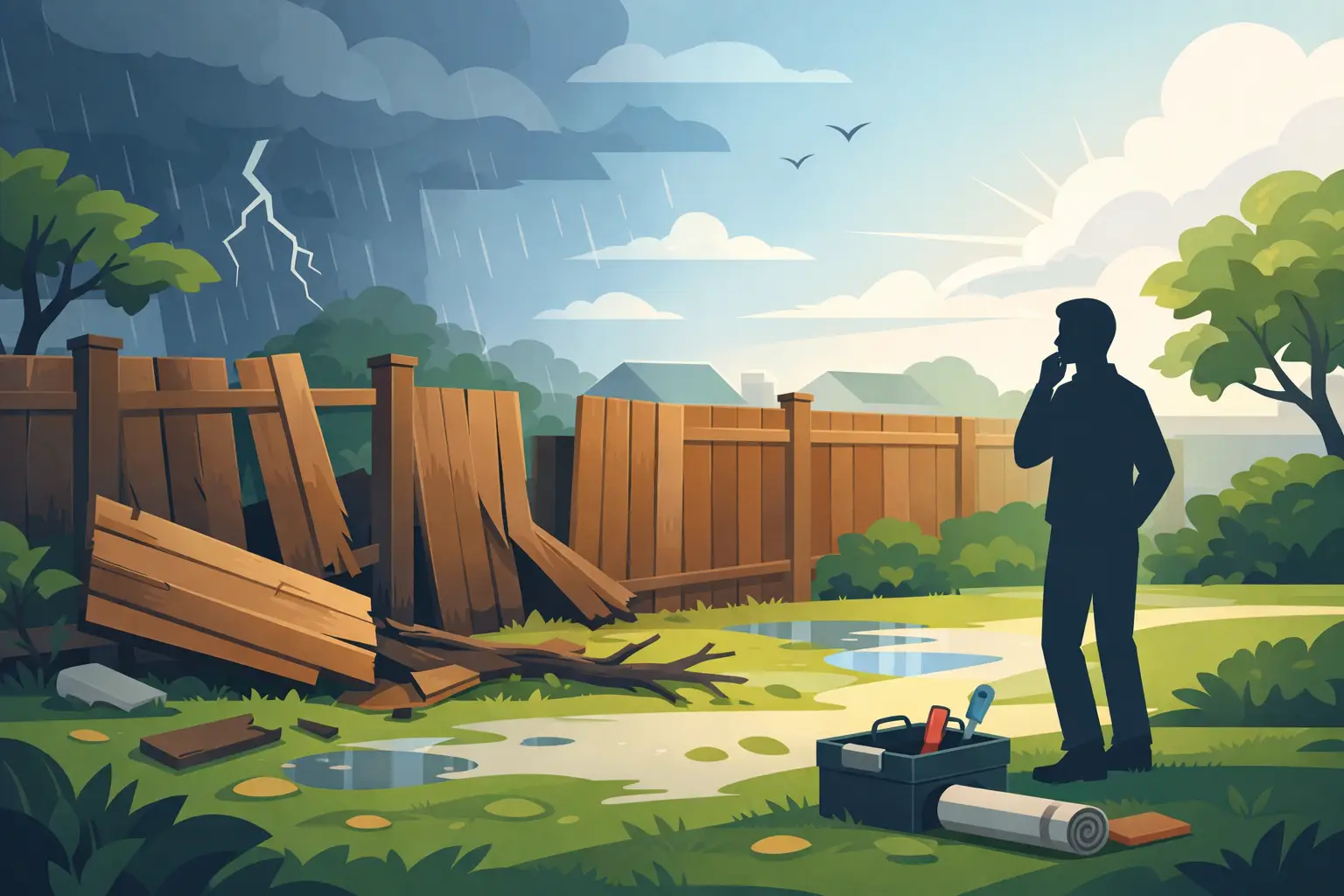
When the wind drops and the garden finally settles, the damage usually looks worse in daylight. Leaning posts, cracked boards and fence panels after storm damage can leave a boundary looking untidy, unsafe and open where it should be secure. For homeowners and landlords across Lancashire, the main question is usually simple - can it be repaired, or does it need replacing properly?
That answer depends on what has actually failed. In some gardens, the panel takes the hit but the posts and gravel boards are still sound. In others, the panel is only part of the problem and the real issue is movement in the posts, rotten timber at ground level or strain across an older run of fencing that was already near the end of its life.
Checking fence panels after storm damage properly
It is tempting to focus on the panel that has fallen out or snapped in half, but storm damage rarely stops at the most visible point. Strong wind puts pressure across the full fence line. One weak section gives way first, yet the neighbouring bays may also have loosened fixings, split rails or slight post movement that will only become obvious in the next spell of bad weather.
Start by looking at the direction of the lean. If a full run is pushing one way, the posts may have shifted in the ground. If only one panel has broken but the posts remain upright and firm, a localised repair may be enough. Check for cracks around post tops, loose arris rails, broken brackets and timber that feels soft or decayed. Concrete spurs, gravel boards and post bases should also be inspected, because they often decide whether a repair will last.
Safety matters here as well. A damaged panel can still be under tension, especially if it is caught against another section or hanging by fixings. If posts are unstable, the fence can come down with very little pressure. That is one reason many property owners prefer a proper site inspection rather than guessing from a quick look from the kitchen window.
Repair or replace?
There is no single rule that fits every fence. A straightforward repair makes sense when the damage is limited and the rest of the structure is still sound. For example, if one panel has cracked in high wind but the posts are solid, the gravel boards are intact and the surrounding timber is in good order, replacing that panel can be a sensible and cost-effective fix.
Replacement becomes the better option when the storm has exposed wider weakness. If multiple bays are loose, posts are leaning, timber is rotting or the fence was already ageing before the weather turned, patching one section may only delay the next failure. In those cases, a new run often gives better value than repeated call-outs and piecemeal repairs.
This is especially true with older fences where previous repairs have been carried out over time using mismatched panels or temporary supports. A boundary may still be standing, but not in a way that offers long-term security or a tidy finish. If appearance matters as much as function, full or partial replacement can make more sense than trying to save materials that are already past their best.
Signs a repair is usually enough
A repair is often realistic if the damage is contained to one or two panels, the posts remain upright, and the rails, fixings and boards around the damaged area are still in decent condition. Where wind has simply dislodged a panel from slotted posts or cracked a section that can be swapped out cleanly, the work is often fairly direct.
The key word is stable. If the rest of the fence line is firm and there is no hidden rot, replacing the affected part can restore the boundary without unnecessary extra cost.
Signs replacement is the safer option
If posts are rocking in the ground, several panels have split, or the fence has a clear overall lean, replacement is usually the more dependable route. The same applies where timber has rotted at the base or repeated storm damage suggests the original installation was not strong enough for the location.
Exposed gardens, corner plots and boundaries facing open ground often need stronger materials and better post support than a basic panel-for-panel swap. A proper replacement allows that to be addressed rather than repeating the same weakness.
Why storm-damaged fencing often fails again
A storm does not always create the whole problem. Quite often, it reveals one that has been developing for years. Timber fencing is under constant pressure from moisture, frost, soil movement and general wear. Once posts begin to weaken or rails start to split, one period of high wind is enough to push the structure beyond its limit.
That is why a very cheap repair can be false economy. Reusing tired posts to support new panels may look acceptable at first, but if those posts are already compromised, the fence can fail again sooner than expected. The same goes for replacing only the most obvious damage while leaving adjoining weak sections untouched.
A good repair should deal with the cause, not just the symptom. If the original fence lacked adequate support, had poor drainage at the base, or used materials unsuited to an exposed garden, those points should be corrected as part of the job.
Choosing the right replacement panel and structure
When replacement is needed, matching the old style is only part of the decision. The more important question is what will stand up best in that particular garden. Different properties across Blackburn, Preston, Burnley and the wider Lancashire area face different wind exposure, soil conditions and layout constraints.
Closeboard fencing is often chosen where strength matters, because it generally copes better with rough weather than lighter decorative options. Concrete posts and gravel boards can also improve durability, particularly where previous timber posts have failed at ground level. That said, not every garden needs the heaviest possible specification. In a sheltered spot, a well-installed timber fence may be entirely suitable and keep the finish in line with the rest of the property.
There is also the issue of appearance. A new section should not just stand firm - it should sit neatly with the property and create a clean boundary line. Landlords may prioritise durability and ease of future maintenance, while homeowners may want a more consistent look across the full garden. Both are valid, and the right solution depends on what matters most at the property.
Insurance, neighbours and practical next steps
Storm damage can raise a few practical questions beyond the fencing itself. If a boundary is shared, it helps to establish who is responsible before work begins. Some title plans clarify this, but not always. In many cases, a sensible conversation with the neighbour is the fastest route, especially where the fence affects both properties.
Insurance may also be relevant, although cover varies. Some policies include storm damage to boundary structures, while others do not or only pay in certain circumstances. It is worth checking before arranging extensive work, particularly if a long run has come down.
In the meantime, speed matters for security and safety. A damaged fence can leave gardens exposed, create risk for children or pets, and make the property look neglected. Temporary making-safe work may be needed before a full repair or replacement is carried out, especially after severe weather when contractors are dealing with high demand.
Getting a long-lasting result
The best outcome is not just a fence that is upright again by the weekend. It is a boundary that is fitted properly, aligned well, supported correctly and suited to the conditions on site. That means looking at post depth, spacing, fixings, ground levels and any weak sections beyond the immediate break.
For that reason, fence panels after storm damage should be assessed as part of the whole fence line, not as isolated pieces of timber. A quick swap can sometimes be enough, but only if the rest of the structure genuinely supports it. If not, a more complete repair or replacement will usually save money and disruption over time.
At Hulme Fencing Lancashire, that practical approach is what matters most - giving property owners a clear view of what can be saved, what needs replacing and what will hold up properly in the next bout of rough weather.
If your fence has taken a hit, the sensible next step is to deal with it before a weakened section turns into a full boundary failure.