
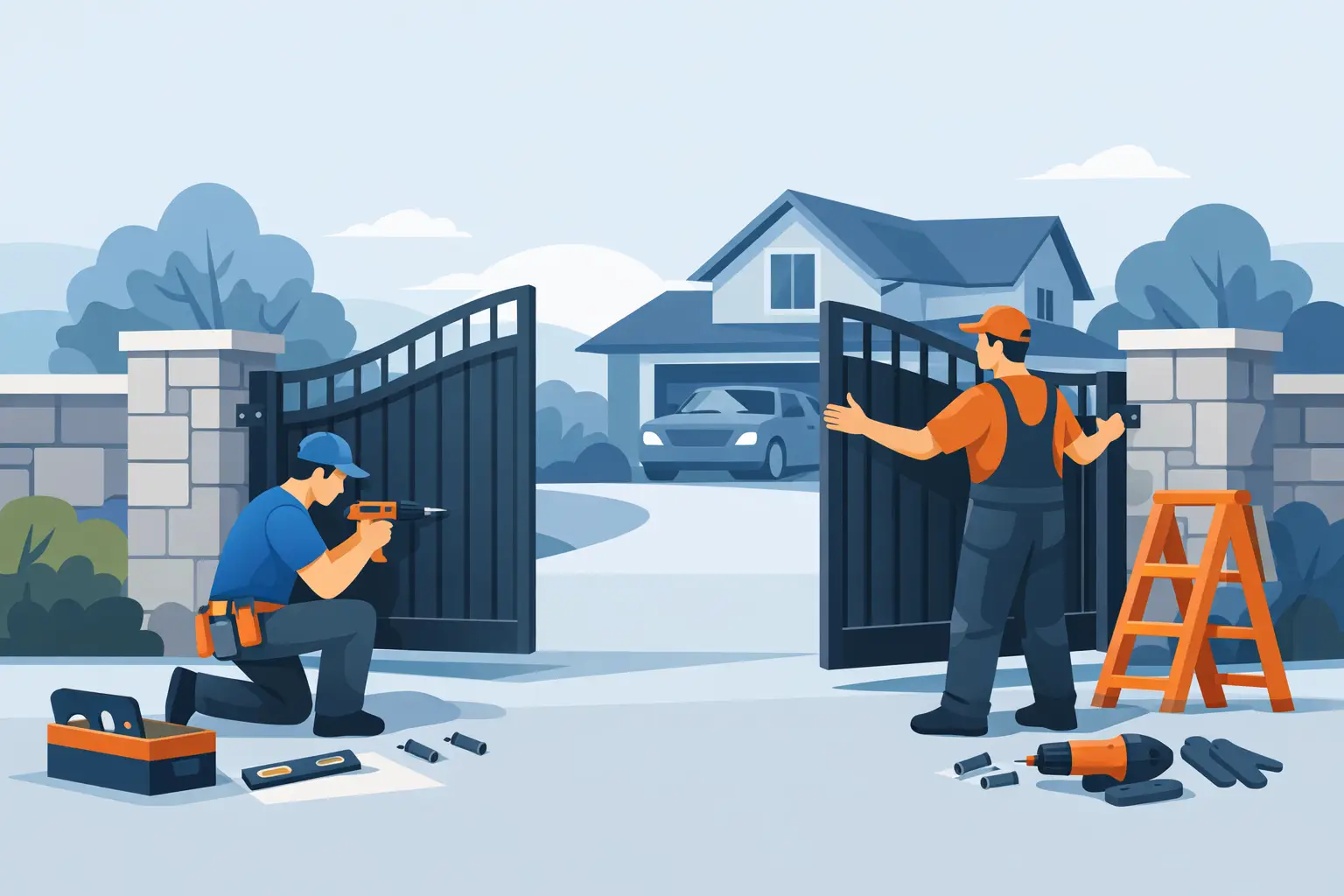
A driveway gate usually looks simple from the road. Two posts, a pair of gates, a latch and the job is done. In practice, driveway gate installation only works well when the opening is measured properly, the posts are suited to the weight of the gate, and the swing or access is planned around how the property is actually used day to day.
For homeowners and landlords across Lancashire, that matters. A gate that drops, catches on the drive, or starts moving in the wind after a few months quickly turns from an upgrade into a nuisance. Done properly, it gives you better security, a tidier frontage and reliable access without constant adjustment.
What good driveway gate installation should achieve
A well-fitted driveway gate needs to do three jobs at once. It should secure the entrance, suit the property visually, and open and close without effort. If one of those elements is off, the whole installation feels second rate.
Security is often the main reason people enquire about a new gate, especially where the front boundary feels too open or vehicles are parked on the drive overnight. But appearance matters too. A driveway gate is a prominent feature, and if it looks undersized, poorly aligned or out of keeping with the house, it can drag down the overall finish rather than improve it.
There is also the practical side. Gates need enough clearance, solid support and sensible hardware. On a narrow drive or a sloping entrance, the wrong gate design can create access problems from the start. That is why installation should never be treated as just hanging a gate between two posts.
Choosing the right gate for the property
The best gate is not always the heaviest or the most decorative. It depends on the width of the opening, the level of privacy required, the available space for swing, and the style of the boundary.
Timber remains a popular choice for residential properties because it works well with fencing, softens the front of the home and can be made in a range of styles from simple framed ledged designs to more substantial tongue and groove or boarded gates. For many Lancashire homes, timber gives the right balance of privacy, strength and appearance.
That said, the design still needs to match the setting. A tall solid gate offers more screening but catches more wind, which places greater demand on posts, hinges and foundations. A more open style may be better for exposed plots or homes where visibility out onto the road is useful. Double gates can suit wider entrances, while a single gate can be the cleaner option for smaller drives.
This is where experience matters. What looks right on paper can behave differently on site, especially if the driveway rises sharply, narrows near the garage, or already has existing pillars or fencing to work around.
Why posts and foundations matter as much as the gate
One of the most common problems with poor driveway gate installation is not the gate itself. It is the support structure. Even a well-made gate will fail if the posts are undersized, set too shallow, or installed into weak ground without proper consideration.
Driveway gates are heavier and work harder than most garden side gates. They open into wind, carry repeated strain through the hinges and, in some cases, get used several times a day. That puts constant pressure on the posts. If those posts move, the gate alignment goes with them.
Timber posts can work well when correctly specified and installed, but for larger or heavier gates, many properties benefit from more substantial solutions depending on the site conditions. The depth of the post holes, the type of concrete used and the curing time all affect long-term performance. Rushing that part of the job often leads to sagging, binding and early repair work.
A proper survey should look at ground levels, drainage, the condition of any existing boundary structure and the likely load on the gate over time. It is not the most visible part of the job, but it is what keeps the visible part working.
Levels, clearance and access planning
A gate can be strong and attractive and still be wrong for the driveway. Clearance is often where issues show up. If the drive slopes up from the road, an inward opening gate may catch the surface unless it is designed with enough lift or planned differently. If the entrance is tight, gates may not open far enough for comfortable vehicle access.
That is why measurements need to go beyond width and height. Installers should consider vehicle turning space, pedestrian access, hinge clearance and where the gate will sit when open. A gate that blocks part of the path or forces awkward reversing is not a good result, even if the workmanship is tidy.
There is also the matter of road position and visibility. In some cases, the gate should be set slightly back from the pavement or road edge to allow a vehicle to pull in safely before opening. That depends on the property layout, but it is an example of how practical planning affects day-to-day use.
Driveway gate installation for security and privacy
Not every customer wants the same thing from a new gate. Some want a clear boundary marker and better kerb appeal. Others mainly want to make access less open and reduce casual entry. The right installation should reflect that.
For stronger privacy, boarded timber gates with limited gaps are often preferred. These help screen parked cars, bins or the front garden from view. For visible deterrence, a taller and sturdier gate with quality ironmongery can make the entrance feel more secure and more clearly private.
Still, there are trade-offs. More privacy usually means more weight and greater wind resistance. Taller gates may also affect the look of the frontage if they are out of proportion with the existing boundary. The best outcome is usually one that improves security without making the entrance feel overbuilt.
Repairs versus full replacement
Some driveway gates can be repaired, but not all are worth saving. If the gate frame is sound and the issue is limited to hinges, latches, dropped alignment or isolated timber wear, a repair may be the sensible route. If the posts are failing, the gate is twisted, or the timber is badly rotted at key stress points, replacement is often better value in the long run.
Trying to fit a new gate onto unstable or ageing posts is a false economy. The same applies where an existing gate has repeatedly been adjusted and still will not sit correctly. In those cases, a fresh installation gives a better result and avoids ongoing call-backs.
At Hulme Fencing Lancashire, this is often where straightforward advice matters most. Customers do not want to spend twice. They want to know whether the existing setup can realistically be made reliable, or whether it is time to start again with something built to last.
What to expect from a professional installation
A professional driveway gate installation should begin with a proper site assessment, not a rough guess from a photo. The installer needs to check measurements, levels, surrounding fencing or walls, access constraints and the condition of the ground. From there, the gate style, post specification and ironmongery can be matched to the job.
The installation itself should be neat and well planned. Old materials should be removed cleanly where required, posts set accurately, hinges aligned properly and all fixings suited to external use. Timber gates should be fitted with enough tolerance to allow movement in changing weather, but not so much that they look loose or poorly finished.
After fitting, the gate should open and close smoothly, sit evenly and latch securely. It should also look right from the road. That final visual check matters more than some contractors admit. A driveway gate is part of the front elevation, and poor symmetry or uneven gaps are obvious every time you arrive home.
Cost depends on more than gate size
People often ask for a rough price based on the gate width alone, but the cost of driveway gate installation depends on several factors. The gate design, timber specification, post type, ground conditions, removal of old materials and complexity of access all play a part.
A straightforward installation on a level drive with good access is naturally simpler than fitting gates on a slope, between existing structures, or where the entrance needs remedial work first. Bespoke sizing can also affect price, but it often leads to a better finish than trying to make a standard gate work in an awkward opening.
The key is to look at value rather than just headline cost. A gate that is fitted correctly, supported properly and made to suit the entrance will usually cost less over time than a cheaper option that needs constant adjustment or early replacement.
Getting the right result locally
For homes across Blackburn, Preston, Burnley and the wider Lancashire area, local knowledge is useful because properties vary so much between terraces, semis, rural homes and newer estates. Frontages differ, ground conditions differ, and what suits one entrance may not suit the next street over.
That is why a measured, site-led approach matters. Good driveway gate installation is not about fitting the fastest option. It is about making sure the gate suits the property, works reliably in daily use and stands up to the weather over time.
If you are considering a new gate, the best starting point is not the catalogue image. It is the entrance you already have, the way you use it, and the standard of finish you want to see every time you pull onto the drive.