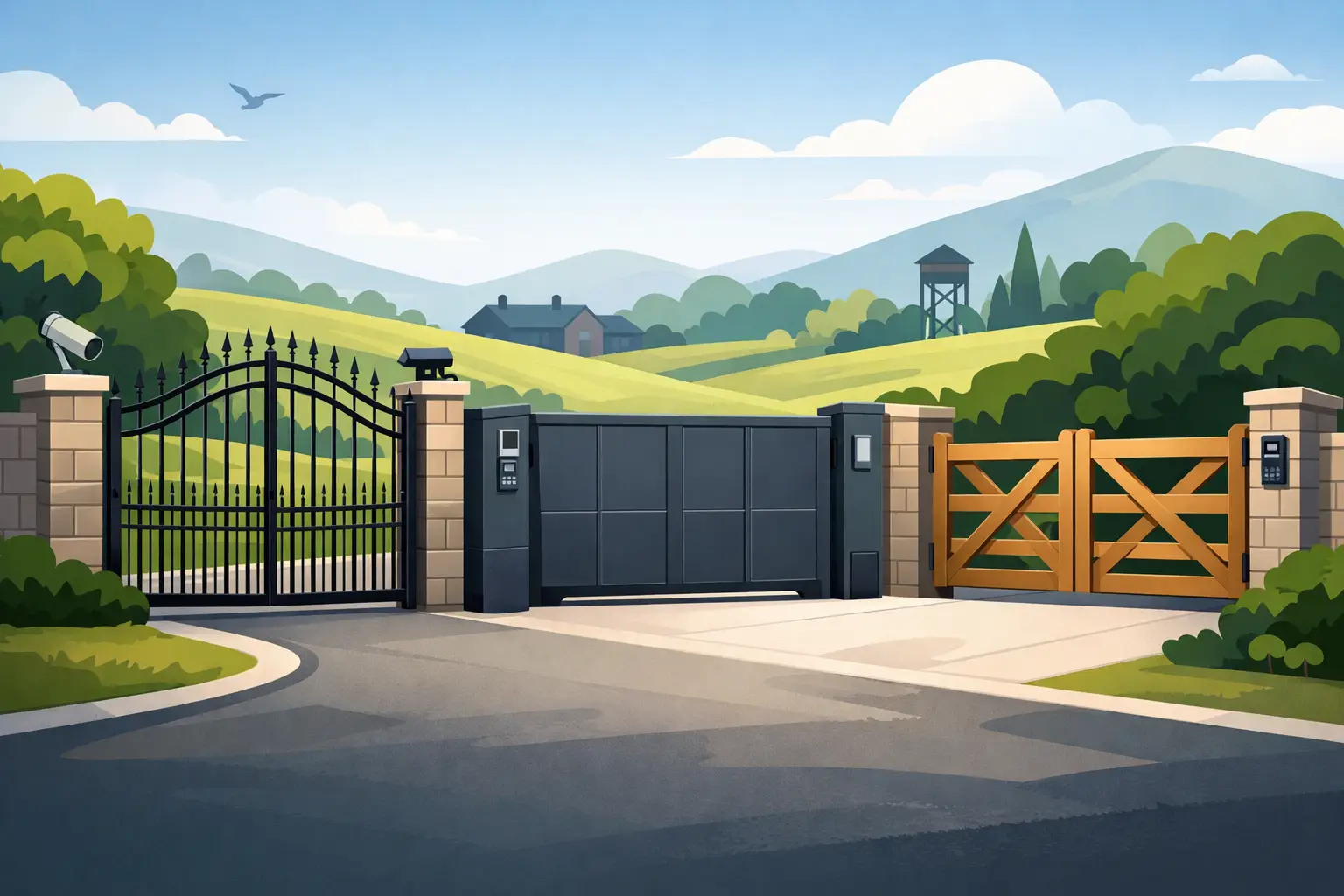
A driveway gate should make it harder for someone to enter your property, while still being easy for your household to use every day. The best driveway gates for security are not simply the tallest or heaviest option. They suit the width and slope of the drive, protect the weak points around the entrance, and are fitted securely to substantial posts or brickwork.
For homeowners, landlords and property managers across Lancashire, the right choice often comes down to balancing security, privacy, appearance and maintenance. A gate that looks smart but sags, has an exposed latch or leaves a gap large enough to bypass the lock will not provide the protection you expect.
What Makes a Driveway Gate Secure?
Security begins with the whole entrance, not just the gate leaf. A well-made gate needs a strong frame, solid hinges, reliable locking and posts that can handle its weight and the force placed on it in poor weather. The fence or wall beside it also needs to be in good condition. There is little value in fitting a secure gate beside a loose panel or low boundary that offers an easier route in.
Height and visibility require some thought. A closeboard or solid timber gate gives good privacy and can prevent casual viewing of vehicles, tools or access points. However, an open design with steel bars can make the driveway more visible from the road and neighbouring homes. That visibility may deter unwanted activity, particularly when paired with good exterior lighting.
The strongest option is not automatically right for every property. A large steel gate may be suitable for a long, wide drive with brick pillars, but it can look out of place or create unnecessary strain on lightweight timber posts. The most dependable result is a gate designed around the site and installed with the correct foundations and fixings.
Best Driveway Gates for Security by Material
Steel gates for maximum strength
Steel driveway gates are a strong choice where physical security is the main priority. They are difficult to force, can be made in traditional or contemporary styles, and work well with automated opening systems. Galvanised and powder-coated finishes help protect the metal from corrosion, which matters in Lancashire's wet weather.
A steel gate can be designed with vertical bars, mesh infill or more private solid sections. Vertical bars are generally preferable to wide horizontal rails because they are harder to climb. Look for welded construction, protected hinge points and a lock housing that cannot easily be reached from outside.
The trade-off is weight. Steel gates need properly engineered posts, pillars or supporting steelwork. They also require careful installation to ensure they open freely and do not drop over time. For an entrance exposed to strong winds, the design may need to allow some airflow rather than acting like a solid sail.
Aluminium gates for low-maintenance security
Aluminium is a practical option for homeowners who want a smart, secure-looking entrance without the weight and ongoing upkeep of steel or timber. Quality aluminium gates are corrosion-resistant, lightweight and well suited to automation. They are available in solid privacy designs, slatted styles and finishes that resemble wood.
Because aluminium is lighter, it can put less strain on hinges and automated motors. It is particularly useful where access is limited or the existing pillars cannot support a very heavy gate. A good aluminium gate still needs a strong frame and secure locking, as thin or poorly built versions can be less resistant to impact than steel.
For many modern Lancashire homes, aluminium offers a sensible balance between security, kerb appeal and straightforward maintenance. Washing it down occasionally and checking the moving parts is usually enough to keep it looking presentable.
Timber gates for privacy and traditional character
Timber driveway gates remain a popular choice for rural homes, period properties and gardens where warmth and natural character matter. A well-built hardwood or pressure-treated softwood gate can provide effective privacy and a substantial physical barrier, especially when made with a braced frame and closeboard, tongue-and-groove or solid-board infill.
Timber needs more attention than metal. It should be treated or finished correctly, maintained over time and fitted with enough ground clearance to avoid sitting in standing water. Gates that stay damp can warp, swell or rot, affecting the latch and their ability to close securely.
For better security, choose a thick framed design rather than a lightweight decorative gate. Fit heavy-duty adjustable hinges, a protected lockable latch and a drop bolt or locking centre stop for double gates. Timber can be an excellent choice, but only when the posts and ironmongery are as strong as the gate itself.
Composite gates for privacy with less upkeep
Composite driveway gates combine a metal frame with durable boards or panels designed to imitate timber. They can offer privacy, a clean modern finish and lower maintenance than natural wood. As with aluminium, build quality varies, so the internal frame and fixing system deserve close attention.
Composite boards alone are not a security feature. The strength comes from the supporting frame, posts, hinges and locks. This option works best where homeowners want a solid, private appearance without regular staining or painting.
Swing, Sliding or Bi-Folding Gates?
The opening method affects both security and everyday practicality. Swing gates are common on residential drives and can be made as one large leaf or a pair of gates meeting in the middle. Double swing gates reduce the space needed behind each leaf, although they need a secure centre stop and properly aligned closing points.
Sliding gates are useful for short or sloping drives where swing gates would obstruct parking or the pavement. A tracked sliding gate needs a clear, level run alongside the entrance, while a cantilever gate avoids a ground track but requires more side room and a more substantial supporting structure. Both can offer very good security when professionally installed.
Bi-folding gates open quickly and need less run-back space than a sliding gate. They can be suitable where speed of access is important, though their mechanism is more complex and should be maintained by a competent installer.
Never allow a gate to open outwards across a public footpath or road. Aside from creating a hazard, it can make safe operation difficult and may cause problems with planning or highways requirements.
Locks, Automation and Access Control
A gate is only secure when it stays locked. For manual gates, a mortice lock, key-operated long-throw lock or high-quality gate lock with a protected keep is usually more reliable than a basic latch. Double gates may also need drop bolts securing into the ground, ideally with a central locking arrangement that prevents either leaf being pushed open.
Automated gates improve convenience, but they need to be specified properly. Remote controls alone are not enough. Consider keypad access, an intercom, video entry or a controlled exit button depending on how the property is used. For rental properties or shared access, a keypad or video system can be easier to manage than handing out multiple remotes.
Safety is essential with automated gates. They should include suitable safety devices, such as photocells and force limitation, to reduce the risk of trapping or impact. Automated systems need routine servicing, particularly after storms, power issues or any impact to a gate leaf. A gate that is slow, noisy or no longer closes squarely should be checked before it damages the motor or compromises security.
Do Not Overlook Posts, Groundworks and Lighting
The best gate can fail if it is fixed to weak posts. Timber posts should be of sufficient size, treated for ground contact and set in stable foundations. Steel posts need appropriate protection and secure concrete footings. Brick pillars may need assessment before a heavy or automated gate is attached, especially if they are old, cracked or built around a narrow footing.
Drainage matters too. Water collecting at the entrance can damage timber, affect sliding tracks and cause ground movement around posts. A professional installation considers levels, clearance, opening direction and drainage before the gate is made or fitted.
Lighting is a useful supporting measure. Motion-activated lights can make an entrance less attractive to opportunists and improve safe access after dark. Position lights so they illuminate the gate, driveway and approach without shining directly into neighbouring homes or causing glare for road users.
Choosing the Right Gate for Your Lancashire Property
For a typical suburban driveway, an aluminium or steel-framed gate with secure locks and a tidy automated system often provides a durable, low-maintenance answer. For a rural or traditional property, a heavy framed timber gate can offer excellent privacy and character, provided it is maintained and fitted to strong posts. Where space is tight or the drive slopes upwards, sliding gates may be the more practical and secure arrangement.
Before ordering, measure the opening accurately and think about vehicle turning space, bin collections, pedestrian access and how the gate will be used in winter. If you regularly return home in the dark or carry children and shopping from the car, automation may be worth the investment. If the gate is primarily there to define a boundary and deter casual access, a well-built manual gate with quality locks may be enough.
Hulme Fencing Lancashire can help local customers assess the entrance, choose a suitable gate style and ensure the posts, fittings and surrounding boundary are ready for a secure installation. The right driveway gate should feel solid every time it closes, look appropriate for the property and give you confidence when you are away from home.